Hong Kong's Rural Fibre Subsidy: Public Funds Delivered No Competition
An engineering and policy analysis of OFCA's Village Subsidy Scheme, revealing how outdoor manhole demarcations, ODN carve-outs, and extreme NIP fragmentation neutralized third-party GPON FTTH.

Hong Kong’s HK$745 million Subsidy Scheme to Extend Fibre-based Networks to Villages in Remote Areas (VSS) appears to be an engineering triumph on paper. By the end of 2025, optical fibre had reached 233 of the 235 target villages—a 99% rollout completion rate.
The scheme carried a second, equally vital policy mandate: introducing retail market competition through mandatory infrastructure sharing, requiring winning operators to open at least 50% of subsidised capacity to third parties.
Audit Commission figures reveal that across six subsidised tender lots, only two Network Capacity Agreements (NCAs) were signed, and as of 31 December 2025, actual third-party commercial utilization across the shared network remains precisely zero.
The market failure is neither an accident nor an operator-specific boycott. It is the inevitable engineering outcome of a sharing framework that offers an unbundled physical-layer conduit while withholding the active facilities, termination nodes, and last-mile distribution networks required to deliver residential broadband.
The Asset Mismatch: Physical Conduits vs. Bitstream Access
The core constraint of the VSS framework is the nature of the wholesale product. Participating operators (HKT and HGC) are obligated to share only passive, physical-layer facilities—either bare dark fibre cores or empty sub-duct space.
| Line-in Connection (LIC) Type | Shared Asset Delivered | Third-Party Scope of Work Required |
|---|---|---|
| Underground Duct (73.3% of HGC lines) | 1/4 space in 107 mm duct | Supply cable (<23 mm OD), blow/pull cable, splice, test |
| Direct Cable Laying | 1/3 of a 100-core cable | Mid-span breakout, outdoor splicing, optical loss verification |
| Submarine Cable (HKT Lots 5 & 6) | 1/5 of a 500-core subsea cable | Land-end splicing, subsea maintenance co-funding |
The scheme does not offer Layer 2 Bitstream, VULA, or active transmission. A competitor cannot simply purchase a wholesale port at an exchange. To light up a single subscriber, a third-party Fixed Network Operator (FNO) must provision upstream backhaul to the hand-off, deploy optical line terminals (OLTs), and construct its own last-mile drop.
The Manhole Trap: Why Demarcations Fail GPON Engineering
For a telecom operator, a network hand-off is traditionally a rack-mounted optical distribution frame (ODF) inside a climate-controlled Meet-Me Room (MMR) with redundant DC power. Under the VSS, the Network Interconnection Point (NIP) is an outdoor utility pit.
Cross-referencing the 108 unique public NIP coordinates and 228 NTP coordinates with the Lands Department Common Spatial Data Infrastructure (CSDI) building and road datasets establishes two defining constraints:
- Zero Indoor Presence: 108 out of 108 NIPs and 228 out of 228 NTPs sit strictly outside building polygons.
- Roadside Alignment: Every NIP is situated within 30 metres of a road centreline (82 are within 10 metres).
These locations are outdoor civil engineering chambers—underground manholes and handholes. They offer zero electrical power, zero environmental cooling, and no physical room for active electronics.
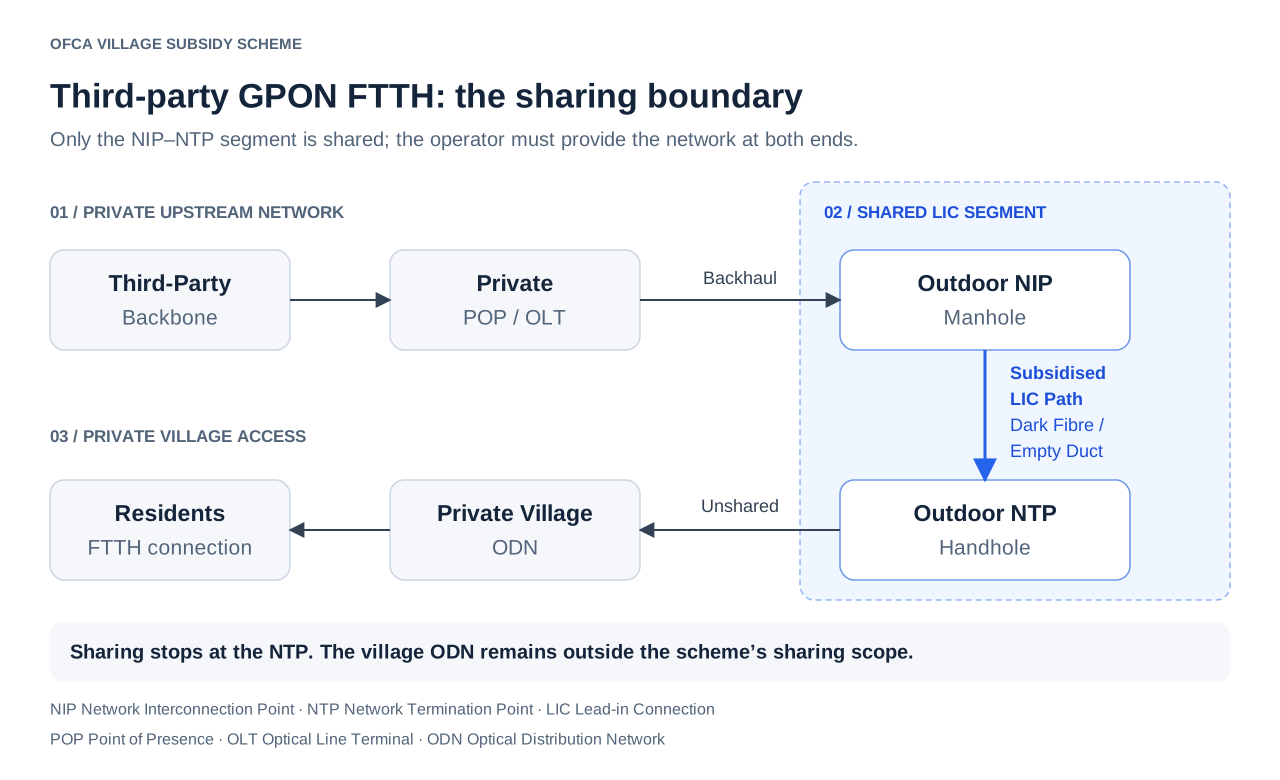
Third-party GPON FTTH architecture: sharing covers only the subsidised NIP–NTP segment. The operator must provide the upstream network and the village access network.
View full-size image (opens in a new tab)To use a shared NIP, an alternative operator cannot simply rack an OLT. It must acquire private land or secure a wayleave within ~1 km of the roadside manhole, install a powered roadside cabinet or container, run backhaul into the NIP, and execute underground fusion splicing under a temporary excavation permit.
The “Post-NTP” Black Hole
The statutory subsidy covers only the Fibre-based Lead-in Connection (LIC) running from the NIP to the Network Termination Point (NTP) at the entrance of a village.
- The Sharing Boundary: The legal obligation to share ends at the NTP.
- The Last-Mile Reality: The Optical Distribution Network (ODN) inside the village—the distribution points (DPs), splitters, pole-mounted fiber drops, and indoor optical network terminals (ONTs)—is entirely unshared.
- Mandatory Dual-Build: Both HKT and HGC must construct or connect their own post-NTP ODN to serve villagers. Any third party must likewise build a parallel distribution network through village alleyways and private lots from scratch.
Overbuilding passive fibre drops inside low-density, scattered village settlements yields negative margins for a challenger. The subsidized backbone stops right where per-subscriber civil costs spike.
Topology and Transaction Friction: 103 NIP Anchors
The scheme splits 230 villages across 103 primary NIP interconnection anchors, establishing two distinct operational profiles:
| Metric | HGC (Lots 1, 3, 4) | HKT (Lots 2, 5, 6) |
|---|---|---|
| Villages Listed | 135 | 95 |
| Primary NIP Anchors | 78 | 25 |
| Median Straight-Line Distance | 0.59 km | 1.91 km |
| Dominant Asset Type | Empty Underground Duct (73.3%) | Fiber Cores & Submarine Cables |
| Topological Characteristic | Extreme Fragmentation (67.9% of NIPs serve 1 village) | Aggregated Choke Points (Subsea landing points) |
In HGC’s territory, two-thirds of the interconnection points serve exactly one village. Multiple NIPs sit less than 100 metres apart (e.g., NIPs for villages 1-47 and 1-54 sit 21 metres apart).
For an entrant, each NIP triggers a separate cycle of formal applications, 10-day notice periods, bespoke NCA legal negotiations, excavation permits, and civil splicing deployments—often to access less than 600 metres of empty pipe. The administrative overhead outstrips the capital value of the shared asset.
The Optical Calculation: Why Centralized OLTs Are Physically Impossible
Could a challenger place high-density OLTs in an existing central data center and illuminate rural subscribers across the shared LIC? Mathematical optical link simulations show this is physically impossible for outlying island clusters.
Simulating an end-to-end link (1310 nm upstream GPON at 1:32 split ratio, with standard connector loss and a 3.0 dB repair margin) demonstrates the physical constraints:
- Urban Hub Direct-Feed to Lamma Island (Scenario F): Siting an OLT in a Hong Kong Island exchange and driving through the Cyberport NIP to remote Lamma villages requires an optical budget of 32.1 dB. This exceeds standard GPON Class B+ (28.0 dB) and Class C+ (32.0 dB) limits.
- Tung Chung Hub Direct-Feed to Cheung Chau (Scenario G): Feeding Cheung Chau from an existing facility in Tung Chung requires 33.5 dB of budget, rendering GPON and standard XGS-PON entirely inoperable.
- The Structural Mandate: OLTs must be positioned within ~1 km of the island NIPs (Cyberport, Pui O, or Mui Wo).
Because direct feeding is optically unviable and NIPs provide no colocation facilities, finding a powered staging facility becomes an unavoidable technical gatekeeper—one entirely omitted from the subsidy scheme’s scope.
The Sai Kung Control Case: Neutralizing the Geography Excuse
Is rural adoption low simply because remote villages lack sufficient demand? The empirical counter-evidence lies in the Sai Kung Old Town NIP (Lot 4).
This single NIP (Coord: 22.381202, 114.270269) links 14 listed village records, 11 of which are dense commercial and residential streets within Sai Kung Town Centre (See Cheung Street, Po Tung Road, Tak Lung Front Street):
- Every NTP is less than 250 metres from the NIP.
- Optical attenuation is negligible (<20 dB).
- Major telco backbones already sit directly adjacent to the site.
- No closed-road permits or subsea cable crossings are involved.
It represents the lowest barrier to entry across all 103 interconnection anchors. Yet, zero third-party capacity has been commissioned here. When a sharing framework fails to generate uptake even in a dense urban core, the underlying failure is driven by contract structure and product definition, not rural geography.
The Asymmetry of Incumbency
While new entrants face fragmented outdoor splices and unpowered manholes, the incumbent operator operates under an entirely different cost structure:
- Brownfield Overlay: HKT can integrate subsidised LIC segments directly into its pre-existing exchanges, duct banks, pole routes, and customer accounts. Field audits across Cheung Chau, Peng Chau, and Lamma consistently show new fiber distribution boxes mounted directly onto legacy copper pole corridors.
- Greenfield Build: HGC constructed substantial rural duct and distribution infrastructure, yet its post-NTP ODN remains similarly proprietary.
- No Deductions for Historic Assets: Public tender records do not demonstrate whether subsidy disbursements accounted for the drastically lower marginal capital expenditure incumbents incur when overlaying existing ducts and poles relative to greenfield operators.
The Reform Blueprint
Physical dark-fibre sharing from unpowered roadside manholes to village boundaries will never support competitive residential broadband. To convert public infrastructure subsidies into genuine market alternatives, four structural interventions are necessary:
- Move Demarcations to Powered Facilities: Transition NIP hand-offs from outdoor manholes to carrier exchanges or powered roadside active cabinets equipped with standardized Optical Distribution Frames (ODFs).
- Standardize Layer 2 Wholesale (Bitstream): Require subsidised networks to offer a regulated Bitstream or VULA wholesale profile, allowing challengers to onboard village subscribers without digging up village footpaths.
- Open the Village ODN: Mandate shared access to the post-NTP passive distribution network—either through shared distribution points (Shared DPs) or open access to aerial line poles.
- Enact Standard Reference Offers (SRO): Eliminate bilateral, point-by-point NCA bargaining. Establish a uniform, OFCA-governed tariff structure covering all 103 NIPs with clear arbitration paths.
Extending physical glass to village perimeters solved the access problem for incumbents. Turning that infrastructure into an open digital commons requires restructuring the regulatory interface from the civil layer up.