The Sandy Ridge Illusion: Why Mega-Datacentres Won't Build Hong Kong's AI Economy
A critical analysis of the Sandy Ridge AI computing project, examining sole-bidder risks, severe utility bottlenecks, compute-export economics, and why raw capacity fails to cultivate a domestic technology industry.

Hong Kong’s Sandy Ridge data-centre development is being marketed as a cornerstone of the city’s AI future. Yet beneath the promotional rhetoric, the public rationale remains fundamentally unproven. The issue is not whether Hong Kong requires computing power, but whether committing a prime land parcel and massive utility capacity to this specific development delivers genuine economic value.
Square footage, rack density, and advertised FLOPS are vanity metrics; they do not automatically foster a resilient domestic technology ecosystem. The central risk is that Hong Kong bears the localized externalities—allocating land, straining the electrical grid, consuming water, and underwriting civil works—while capturing almost none of the high-margin economic value generated by the compute. The government has yet to explain why this rural mega-site offers a superior path for Hong Kong’s digital economy over existing commercial alternatives.
This analysis reflects public records available through 10 September 2026. While Sandy Ridge is privately funded and built, it is a government-initiated land grant. The developer’s private capital commitment does not absolve policymakers from justifying the public land allocation, utility prioritization, and long-term economic trade-offs.
A Sole Bidder Exposes a Lack of Market Validation
The government received exactly one tender for the Sandy Ridge site. It subsequently awarded the plot to HK Range Intelligent Computing Technology Company Limited for a premium of HK$581 million under a 70% technical and 30% price assessment weighting. (Government award announcement)
In mega-infrastructure, a single tender is not proof of decisive execution; it is a clear symptom of weak market appetite. When global and regional hyperscalers decline to bid, it indicates that the site’s commercial terms, geographic constraints, and operational obligations failed to persuade the wider industry.
A single bid concentrates massive delivery risk within a single development consortium. It demands a much higher standard of public scrutiny:
- What verified market demand convinced officials that this development is commercially viable?
- How much institutional project financing is unconditionally committed?
- What volume of IT load is backed by binding off-taker pre-leases?
- What contractual penalties or clawbacks exist if the developer misses delivery milestones or downsizes the facility?
Press releases announcing capital expenditure targets are marketing statements. They are not equivalent to committed funding, verified off-takers, or a de-risked delivery schedule.
Greenfield Remote Sites Create Severe Utility Bottlenecks
Sandy Ridge’s remote footprint introduces structural civil engineering dependencies that cannot be neglected. Operating modern hyperscale facilities requires massive baseline power, continuous cooling water, robust effluent disposal, and dense fiber routing.
Published planning submissions reveal the sheer scale of the engineering overhead involved:
- IT Load: 220 MW
- Gross Grid Connection: 470 MW, demanding dedicated substation infrastructure
- Potable & Cooling Water Demand: 13,100 cubic metres per day (Published engineering and planning appendices)
While rural data centres are technically feasible, the government’s declaration that the site was already under construction in August 2026 bypasses critical operational questions. (August government statement)
Civil construction on a building shell is meaningless if utility energization lags behind by years. The public is entitled to a reconciled, transparent commissioning matrix detailing the delivery timelines for grid substations, water mains, and redundant transit backhaul—alongside an explicit accounting of who absorbs civil overrun costs.
Exporting Compute Is Not the Same as Building an AI Industry
Data centres that anchor domestic financial institutions, regional enterprise headquarters, and local tech firms generate broad economic multipliers. They embed high-skilled engineering talent, software development, and direct corporate taxation inside the territory.
An export-oriented AI computing facility operates under a completely different dynamic:
- Workloads arrive remotely via network routes.
- Model architectures, fine-tuning intellectual property, downstream application software, and the eventual monetization stay outside Hong Kong.
- Hong Kong acts merely as a low-margin digital utility—supplying power, physical cooling, and rack space while absorbing environmental overhead.
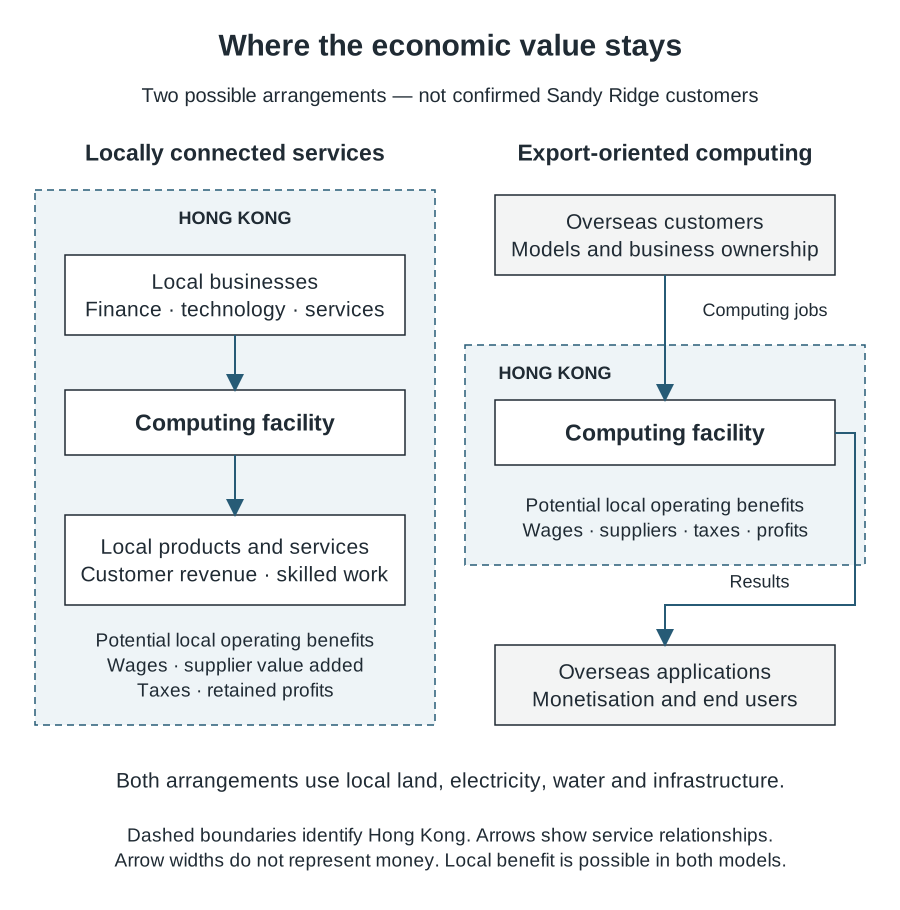
Domestic value retention versus offshore compute arbitrage. In a pure export model, Hong Kong absorbs the localized externalities—grid strain, cooling water, and dedicated land—while software IP, algorithmic capital, and commercial monetization remain anchored abroad.
View full-size image (opens in a new tab)Procuring high-end server clusters does not constitute a technology policy. The vast majority of hardware expenditure leaves the territory directly for overseas silicon foundries and server OEMs.
Official budget disclosures confirm that compute allocation is left entirely to the developer’s private commercial discretion. The administration has established no subsidized capacity pool, no guaranteed allocations, and no preferential pricing for local university researchers or domestic tech startups. (2026–27 budget replies)
If Sandy Ridge is an offshore compute-export operation, it should be evaluated strictly as a low-margin utility business. If it is marketed as a catalyst for domestic AI development, the administration must demonstrate how local industry will access that compute at competitive terms. Conflating these two outcomes is dishonest policy.
Recurring Power Tariffs Outweigh Upfront Land Subsidies
Hong Kong cannot assume an electricity cost advantage when competing for internationally mobile computing workloads. AI training clusters are indifferent to national borders; workloads will migrate wherever the total cost of compute is lowest.
While tariff structures involve multiple tiers, peak-demand charges, and fuel adjustments across jurisdictions, Hong Kong’s commercial tariffs face severe competitive pressure from regional peers like Malaysia. (CLP’s 2026 tariff tables, TNB’s tariff framework)
At hyperscale, minor tariff differentials compound into massive structural deficits:
- Hypothetical IT Load: 220 MW
- Design PUE: 1.25
- Annual Power Consumption (Continuous): 2.409 billion kWh
- Sensitivity Penalty: A delta of just HK$0.10 per kWh imposes an annual operating penalty of HK$241 million.
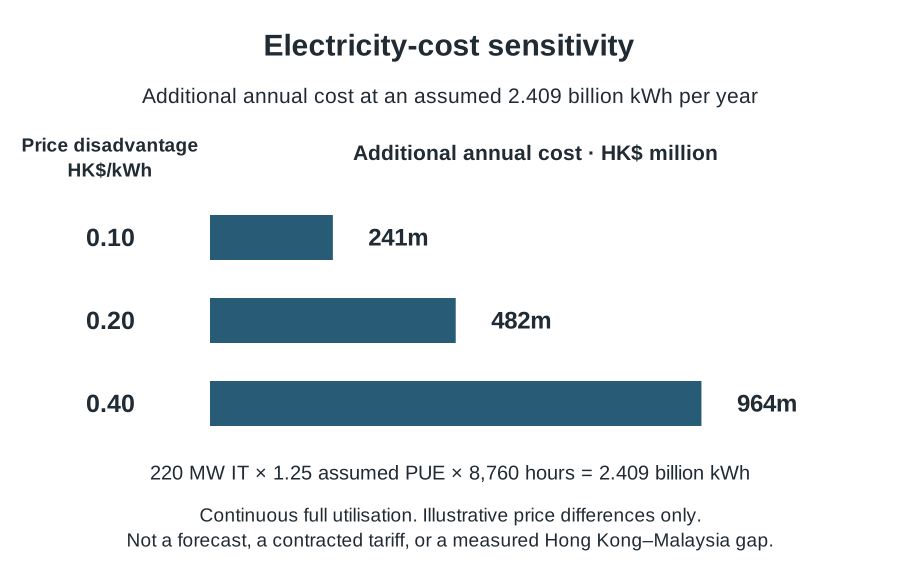
Hyperscale power cost sensitivity based on a 220 MW IT load at 1.25 PUE (2.41 billion kWh annually). At this baseline, even fractional tariff disadvantages against regional competitors like Malaysia compound into hundreds of millions in recurring penalties—rapidly wiping out one-off land premium discounts.
View full-size image (opens in a new tab)A discounted land premium paid once cannot compensate for an ongoing, structural operational cost deficit. If the facility’s commercial viability relies on behind-the-scenes utility concessions, those subsidies must be exposed to public scrutiny.
The Private Sector Has Already Solved Urban Hyperscale
The commercial market has already demonstrated that high-density, AI-ready capacity can be delivered without carving out unserved greenfield sites.
Equinix launched its HK6 facility in June 2026, delivering an initial 1,000 cabinets equipped with direct connectivity to the Hong Kong-Shenzhen Innovation and Technology Park. (HK6 opening announcement)
More tellingly, Goodman’s Tsuen Wan West redevelopment campus already integrates four operational facilities backed by 225 MW of secured electrical capacity. (Goodman campus information)
While commercial colocation campuses operate under different leasing models than a single-tenant mega-site, their success raises a decisive question: what strategic public objective does Sandy Ridge accomplish that established urban carrier hotels have not already delivered with private capital?
The Strategic Alternative: A Resilient, Networked Compute Fabric
Assembling massive, contiguous land plots in Hong Kong is an uphill battle. Repeating this land-heavy approach for every generation of data infrastructure is a dead end.
A viable, modern alternative is a distributed computing fabric: interconnecting dense, distributed urban facilities across low-latency, high-count metro dark-fiber rings.
Physical latency and cluster interconnects remain real constraints; latency-sensitive frontier model training cannot be scattered arbitrarily across a city. However, modern workloads are evolving rapidly:
- AI inference workloads, retrieval-augmented pipelines, and parameter serving are natively parallelizable across distributed sites.
- Emerging distributed training architectures and communication-efficient algorithms (such as DeepMind’s DiLoCo) drastically compress cross-node synchronization requirements. (NVIDIA inter-DC networking analysis, DeepMind DiLoCo paper)
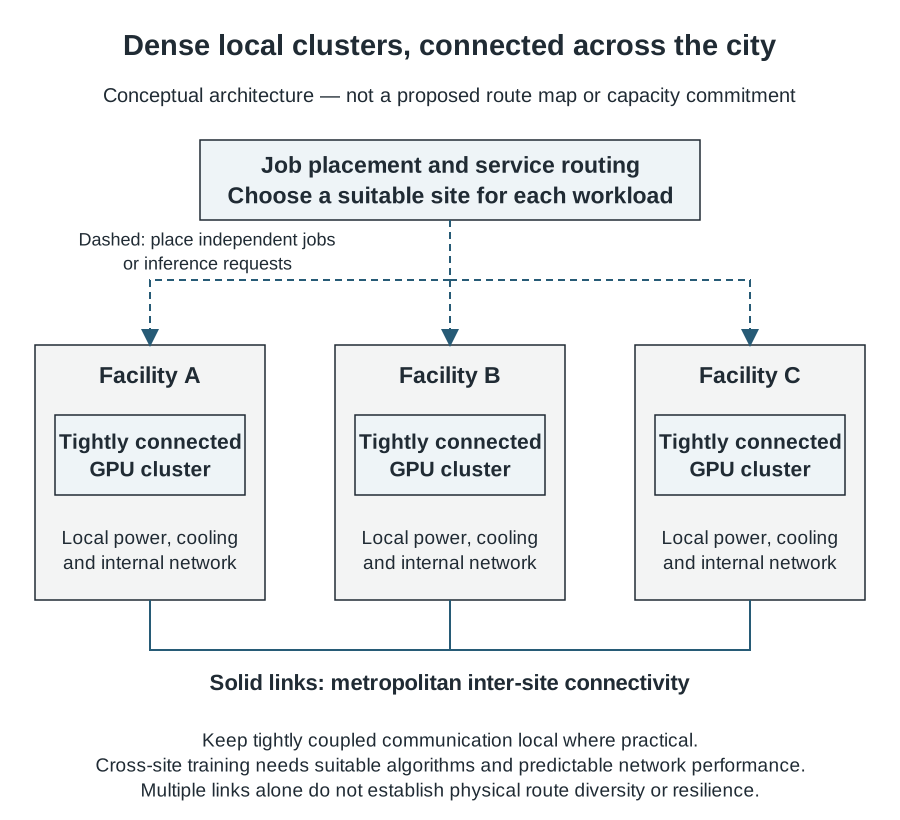
Distributed metropolitan compute fabric versus a monolithic mega-campus. Interconnecting existing urban carrier facilities via redundant, low-latency metro dark fiber pools GPU capacity across diverse failure domains, bypassing the multi-year civil and utility bottlenecks of a remote greenfield build.
View full-size image (opens in a new tab)Investing public resources into high-capacity municipal fiber corridors and shared interconnects would democratize access across multiple data centre operators, instead of betting hundreds of millions on an isolated single-site monopoly.
What the Public Record Must Disclose
Scepticism toward Sandy Ridge is not a rejection of digital infrastructure; it is an insistence on public accountability. The administration has not demonstrated that Sandy Ridge is a sound allocation of public resources or a genuine catalyst for local innovation.
Before more public capital and utility capacity are committed, five concrete disclosures are necessary:
- Binding Commercial Commitments: Audited proof of committed project financing and binding pre-lease agreements for each deployment phase.
- Reconciled Utility Milestones: A synchronized delivery schedule for substation energization, water infrastructure, and backhaul trunking, stating explicitly who bears the cost of delays.
- Transparent Workload Accounting: A clear operational split between offshore compute-export revenues and direct domestic enablement.
- Mandated Local Access Quotas: Legally enforceable frameworks reserving low-cost compute pools for Hong Kong universities, research institutes, and startups.
- Urban Network Benchmarks: A rigorous cost-benefit comparison against urban brownfield retrofits and public investment in shared metropolitan dark-fiber rings.
Hong Kong should measure its digital infrastructure by the domestic value it retains, the technical talent it anchors, and the local businesses it scales. Announcing billions in capital expenditure and hundreds of megawatts of power consumption is easy. Proving that the public actually benefits is the part that remains unanswered.